Meet Phoenix dactylifera, the Tree Behind Rutab
Before the fruit, know the tree. Phoenix dactylifera is the botanical name of the date palm, a member of the palm family (Arecaceae). The species is dioecious: male and female flowers grow on separate trees. Only female palms bear fruit, and they need pollen from a male palm to set it. This is the botanical foundation that makes rutab, the fresh wet date, possible at all.
Understanding fruit structure is not merely academic. Anatomy explains why rutab skin is thin and peels easily, why the flesh is thick and melting, and why a date holds a single hard pit. Let us work from the outside in.
Date Fruit Anatomy: The Three Pericarp Layers
Botanically, a date is a single-seeded drupe (stone fruit), in the same group as cherry, mango, and olive. The fruit wall, or pericarp, has three layers running from outside to inside. This structure is described consistently in date-fruit literature, including reviews in Springer journals and the ScienceDirect database.
| Layer | Also Called | Description & Role in Rutab |
|---|---|---|
| Exocarp | Epicarp / skin | Thin outer layer. At the rutab stage the exocarp thins and loosens so it peels readily; color shifts from yellow-red (khalal) to amber-brown. |
| Mesocarp | Flesh | The thickest layer and the part we eat. Built of sugar-storing parenchyma cells with several tannin-cell layers between them. Softening of the mesocarp is what makes rutab melt in the mouth. |
| Endocarp | Seed membrane | A thin papery membrane wrapping the seed. Unlike other drupes (such as peach), whose endocarp is the hard stone, in dates it is the seed itself that is hard. |
At the center sits one hard, grooved seed (kernel). In many drupes the hard part is the endocarp; in dates the hardness lives in the seed while the endocarp is only a thin membrane. Popular articles often get this small detail wrong.
Why Rutab Flesh Softens
The mesocarp holds the secret of rutab texture. As the fruit ripens from khalal to rutab, the parenchyma cell walls break down and the tannins that make khalal taste astringent decline. The once apple-crisp flesh turns soft, sweet, and melting. This runs in parallel with moisture falling to roughly 30 to 45 percent per FAO data, which we cover fully in our article on the moisture and sugar content of rutab dates.
From Flower to Fruit: Pollination and Timeline
In the wild, dates are pollinated by wind and insects. On commercial farms, growers hand-pollinate to guarantee a crop. Once pollination succeeds, the fruit develops through five long stages.
- Hababouk — tiny new fruitlet, about one gram, still wrapped by the calyx; lasts four to five weeks.
- Kimri — enlarging green fruit; the longest phase, roughly two to five months after pollination.
- Khalal — maximum physiological size; yellow to red, crisp texture.
- Rutab — flesh softens and browns; lasts only about two to four weeks.
- Tamr — fully dried ripe date; the whole journey from flower to tamr takes about two hundred days.
For the quantitative detail of each stage, see our pillar on the maturation stages of dates from hababouk to tamr. The takeaway here: rutab is a very narrow window, a botanical reason why fresh dates are seasonal.
Indonesia Harvests Its Dates at the Rutab Stage
Anatomy and climate together explain one striking local fact. Dates grown in Indonesia are usually harvested at rutab, not tamr, because high tropical humidity prevents the fruit from drying to tamr on the tree. According to Indonesia's Directorate General of Horticulture and reports by Trubus and Liputan6, harvest typically happens around 150 days after pollination, while the fruit is still wet and yellow-brown.
The most cultivated variety is KL-1, a Barhi x Deglet Noor cross originating in Thailand that adapts to tropical climates. At the Indonesian Date Palm Association (IDPA) research garden in Pekanbaru, Riau, KL-1 reportedly fruited at about three years old. Other growing centers include Pasuruan, Magetan, and Aceh. A note: we present this as botanical education, not as a sale of local dates.
Why This Anatomy Matters to You
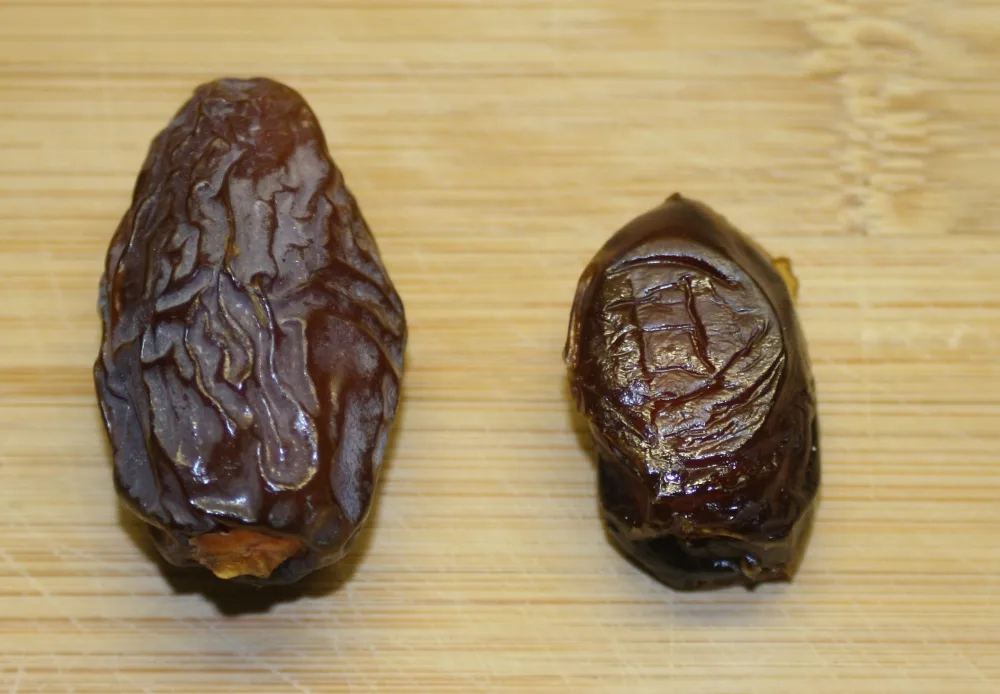
Knowing the anatomy helps you judge quality. The thick flesh you enjoy is mesocarp; the riper toward rutab, the softer it gets as cell walls dissolve. The thin peeling skin is exocarp. And the single central seed marks a fully developed, healthy fruit. Our Rotab Bam (Mazafati), positioned as the purest rutab, shows this wet mesocarp clearly when halved, while Medjool Palestine displays the thick flesh typical of a large drupe. Botany, in the end, is the best way to read what is in your hand.
A Date Is a Drupe, but Not Like a Peach
Calling a date a drupe can confuse people, because the drupes we know best, peach, cherry, and mango, have a hard stone (endocarp) wrapped around a soft seed. In a date the pattern is reversed: the endocarp is only a thin papery membrane, while the hardness lives in the seed itself. For that reason some botanists describe the date as a distinctive hard-seeded drupe. The consequence is real at the rutab stage: with no hard stone enclosing it, the entire mesocarp can soften evenly almost down to the seed, giving a melting sensation hard to find in other stone fruits.
The Date Seed: More Than a Byproduct
The single central seed is often treated as waste, yet botanically it stores food reserves for the embryo and economically it has value. Roasted and ground date seeds are used as a caffeine-free coffee substitute, a source of fiber, and a base for date-seed oil in cosmetics, as documented in studies on the valorization of date byproducts. Recognizing the seed as a living structure rather than a mere stone completes the anatomical picture: the skin protects, the flesh feeds, and the seed carries the plant's life into the next generation.
Date Fruit Composition in Numbers
Anatomy gets clearer when translated into proportions. In a ripe date the flesh (mesocarp) makes up the largest share, while the seed is relatively small. The table summarizes a general picture of proportions and the moisture change across stages, drawing on date-fruit botany literature and FAO post-harvest data; figures are ranges because they vary by variety.
| Part / Parameter | General Picture |
|---|---|
| Mesocarp (edible flesh) | ~85–90% of fruit weight |
| Seed (kernel) | ~10–15% of fruit weight |
| Khalal moisture | ~50–85% |
| Rutab moisture | ~30–45% |
| Tamr moisture | <25% (down to ~10%) |
Two things stand out. First, almost all the mass we enjoy comes from a single layer, the mesocarp, so flesh thickness is a sensible quality marker. Second, the journey from khalal to tamr is essentially a story of water loss: once moisture crosses below about 25 percent, the fruit turns from perishable rutab into self-preserving tamr. Anatomy and chemistry are two sides of the same coin.
Summary
A date is a single-seeded drupe with a three-layer pericarp: exocarp, mesocarp, and endocarp. Softening of the mesocarp and loss of tannins turn crisp khalal into melting rutab, within a two-to-four-week window after a long journey from pollination. In Indonesia, the tropical climate forces harvest at the rutab stage. This anatomy is the foundation that explains the taste, texture, and season of fresh dates.